What is a Fractional CFO? (The Accountant's Guide to Scaling a Firm)

A fractional Chief Financial Officer (CFO) is an on-demand, high-level financial strategist who helps a firm scale its operations, optimize its margins, and engineer growth on a part-time or project basis.Think of them as the high-impact architect for your financial practice. You get the executive vision needed to turn a busy practice into a highly profitable enterprise, without the overhead of a full-time C-suite salary.
As the leader of a tax, accounting, or bookkeeping firm, you are excellent at managing financial data for others. But working in your business often leaves zero time to work on your business.
Here is how a fractional CFO applies high-level financial engineering to the unique challenges of running a financial services firm.
The Internal Firm Hierarchy
In a financial sector firm, it is easy for lines to blur. Partners often get dragged down into client-facing technical work rather than driving enterprise value. A fractional CFO repositions the lens entirely inward.
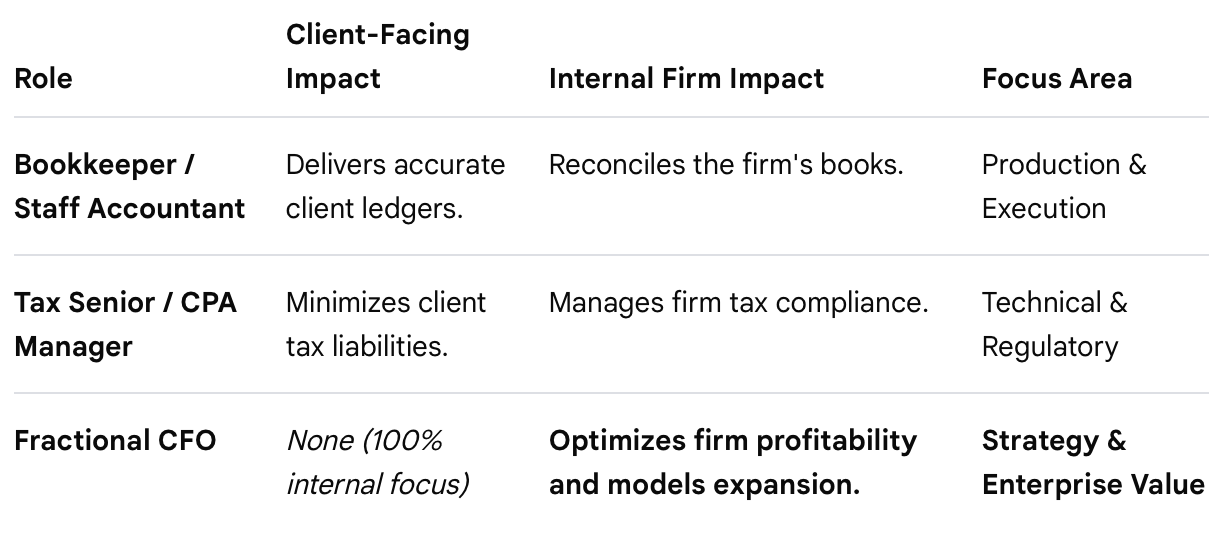
The 3 High-Impact Pillars: How They Transform a Financial Firm
A fractional CFO treats your tax and bookkeeping firm like the high-margin corporate entity it should be. They focus on three specific internal pillars:
1. Capacity Modeling and Workforce Optimization
Utilization Rate Analysis: Pinpointing exactly how profitable your staff accountants and bookkeepers are relative to their hourly or salary costs.
Hiring Frameworks: Forecasting exactly when to hire the next senior accountant before your team burns out during busy season, ensuring revenue covers the new overhead seamlessly.
2. Pricing Architecture & Margin Engineering
Value-Based Pricing Models: Helping you transition away from the "billable hour trap" and move into fixed, high-value recurring revenue packages.
Client Rationalization: Analyzing your roster to identify low-margin, high-friction clients that are draining your team’s capacity and holding back your firm's profitability.
3. Growth Modeling & M&A Readiness
Mergers & Acquisitions: Building the financial models required to swallow a retiring CPA's book of business or prepare your own firm for a lucrative equity partnership.
Service Line Expansion: Mapping out the financial viability and cash flow runway needed to launch a new department, such as specialized advisory or advisory-as-a-service.
The ROI: When Does an Accounting Firm Need a CFO?
You already know the numbers, but applying them to yourself is a different story. If your firm is generating between $500k and $5M in revenue, you are likely too big to run on instinct, but too lean to justify a full-time $250,000 CFO.
By retaining a fractional executive for just a few hours a month, you convert that massive fixed overhead into a scalable operating expense.
Signs your tax and bookkeeping firm needs internal CFO support:
You are trapped in "busy season triage" year-round and can't find time to strategize.
Top-line revenue is growing, but your partner distributions and net margins are stagnant.
You want to acquire another practice or prep your own firm for an exit, but lack a structured valuation or forecast.
You struggle to price your own advisory packages accurately and profitably.
A fractional CFO shifts your firm out of defensive, reactive execution and moves you into aggressive, scalable market leadership. They give you the clarity to run your financial practice with the same strategic rigor you recommend to your highest-value clients.