The Human Edge: Why AI Can’t Replace Your Tax and Bookkeeping Firm

Artificial Intelligence can crunch numbers at lightning speed, but it cannot run a successful financial practice alone. While tools like automated data entry, smart categorization, and AI-driven tax research have completely transformed the financial sector, they have also exposed a critical truth: software lacks the judgment, contextual nuance, and human empathy required to handle complex financial ecosystems.
For business owners and firm partners alike, the promise of "fully automated AI accounting" is a dangerous illusion. Algorithms excel at following structured rules, but tax codes and business growth are rarely neat, orderly, or predictable.
Here is a look at the critical gaps AI cannot bridge, and why the human element remains completely irreplaceable in taxes and bookkeeping.
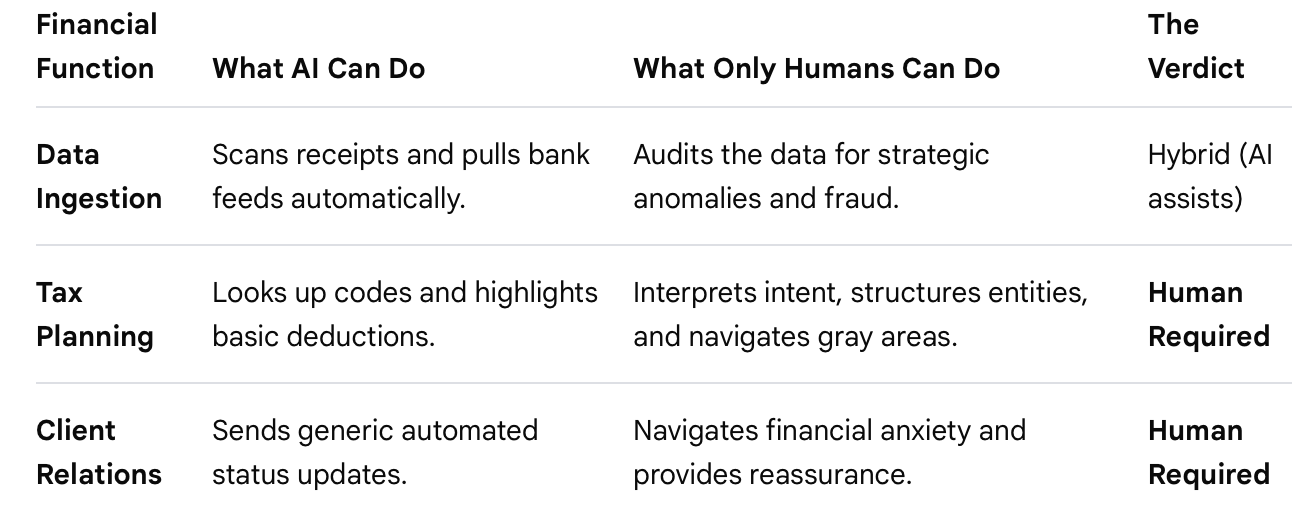
The Human vs. AI Capabilities Grid
To understand where automation falls short, it helps to look at how basic processing differs from high-level financial execution. Check out the grid below.

3 Fatal Flaws of Purely AI-Driven Finance
When you strip human oversight out of bookkeeping and tax operations, you risk exposing a business to three massive systemic vulnerabilities:
1. The Disconnect of "Contextual Blindness"
The Missing Story: AI looks at a bank transaction as an isolated data point. It doesn't know that a specific dinner expense was a critical client pitch, or that a large equipment purchase was part of a long-term capital restructuring plan.
The Danger: Without human context, AI defaults to rigid rules. This leads to misclassified transactions, missed deductions, and messy general ledgers that require hours of human cleanup at year-end.
2. The Illusion of Perfect Tax Code Interpretation
The "Gray Area" Trap: The tax code is not a math problem with a single right answer; it is a complex framework of laws filled with ambiguity and intent. AI operates strictly in black and white.
The Danger: AI cannot defend an aggressive tax position during an audit. It doesn't understand court precedents, changing local regulations, or the subtle nuances of IRS taxpayer intent. True tax mitigation requires creative, human problem-solving.
3. The Absolute Lack of Emotional Intelligence
The Advisory Gap: Money is deeply personal and highly stressful for business owners. AI cannot sit across from a panicked founder who is struggling with cash flow, look them in the eye, and map out a calm, reassuring path forward.
The Danger: Clients don't just buy data; they buy peace of mind. An algorithm can generate a beautiful graph, but it cannot build a relationship built on trust, accountability, and shared professional experience.
The Future: The "Cyborg" Firm Wins
The goal shouldn't be to fight AI, nor should it be to surrender to it. The future belongs to the firm that leverages tech to eliminate friction, while doubling down on human advisory.
By letting AI handle the mundane, repetitive tasks—like OCR scanning and basic data entry—accountants and bookkeepers are freed up to do what they do best: interpret data, build strategies, and act as trusted partners. Tech makes the firm faster, but humans make it valuable.